Early Cinema
The pre-classical period where attraction, spectacle, and new forms of spectatorship take shape.
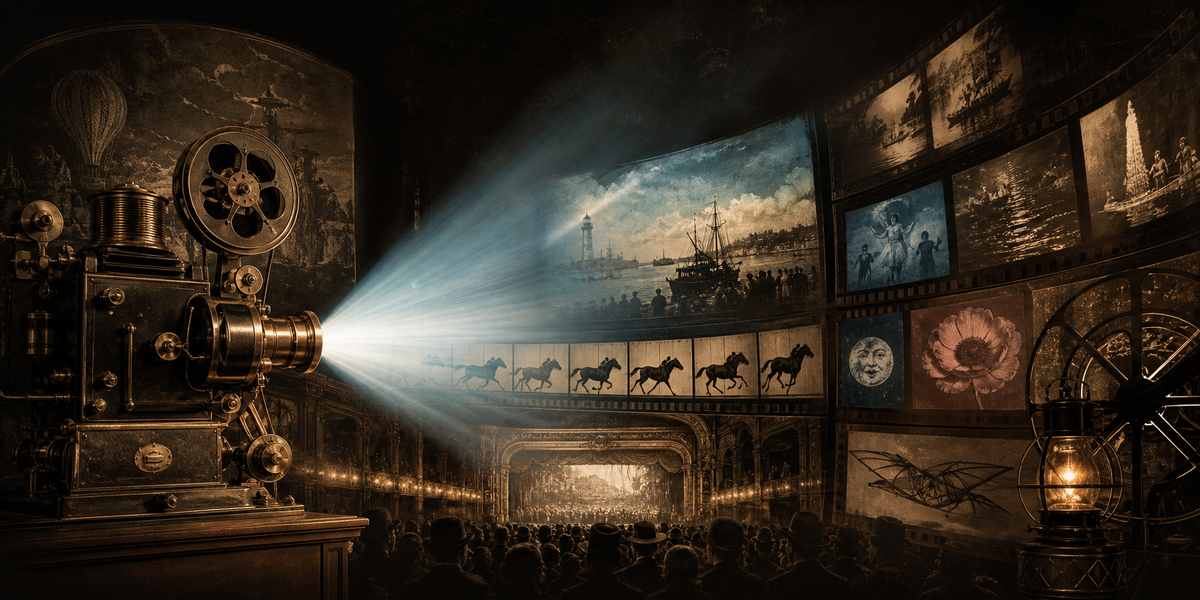
Early cinema matters on this site because it preserves possibilities that later narrative film partly disciplines away. The Cinema of Attractions — the site’s translation of Tom Gunning’s foundational essay — is central because it refuses to treat pre-1906 cinema as an awkward apprenticeship for classical storytelling. Gunning’s argument, as the translation puts it, is that early film organized a different relationship between film and viewer: one built around exhibition, sensation, and direct address rather than immersive narrative. Méliès himself, quoted in the essay, makes the priorities explicit: plot and story were “considered last,” providing only the pretext for special effects and theatrical setpieces.
The essay reads early cinema as Léger praised it — the medium’s force lying in its capacity to show, to take control of visibility. The “cinema of attractions” stages that exhibitionist face: actors look at the camera, magicians bow, comedians wink at the audience. Where Christian Metz’s “voyeuristic” face of cinema would later become the dominant model, the attractional face is its forgotten twin — and the essay tracks how it persists, even after narrative takes over, in the avant-garde and inside specific genres like the musical. Hale’s Tours — the early-1900s chain of theaters built to look like train carriages, complete with ticket-takers and the simulated sounds of wheels and air brakes — is offered as evidence that cinema was at one point closer to the amusement park than to the classical theater.
On Christian Metz sits next to the Gunning translation as a productive counter-pressure. Metz’s narrative-fiction-centric semiology takes the post-1906 settlement as cinema’s center of gravity and builds outward from there; Gunning’s essay shows how much of cinema’s possibility space gets occluded when that move is taken for granted. Everything You Want to Know About Film Studies keeps the historical perspective alive in another register, by returning repeatedly to Lumière, Edison, and Méliès to argue that what now feels like the “natural” syntax of cinema — close-ups that don’t horrify viewers, cuts that don’t disorient them, narrative immersion that makes the camera invisible — was learned, not given.
Early cinema is also where this site’s interest in framing and aspect ratio reaches further back than the multiplex. The circular iris masks of Mount Everest (1924), True Heart Susie (1919), Abel Gance’s La Roue — discussed in Three Lessons on Cinematic Framing and reactivated by Feng Xiaogang’s I Am Not Madame Bovary (2016) — make early cinema something like a reservoir of options rather than a closed period. That is what keeps it alive across the site: it reopens questions about spectatorship and formal experimentation, and it reminds the reader that many things now treated as “natural” features of cinema were once only one option among several.
Related
Read Next
- 景观电影, 早期电影,其观众,以及先锋派
A seminal paper in cinema studies, still relevant to this day
- On Christian Metz: Cinema and Language
“We shape our tools and thereafter our tools shape us.” — Marshall McLuhan
- Everything you want to know about film studies...
...but didn’t know how to ask