Memory
Memory as cinematic structure, emotional depth, and a recurring thread in the site's film writing.
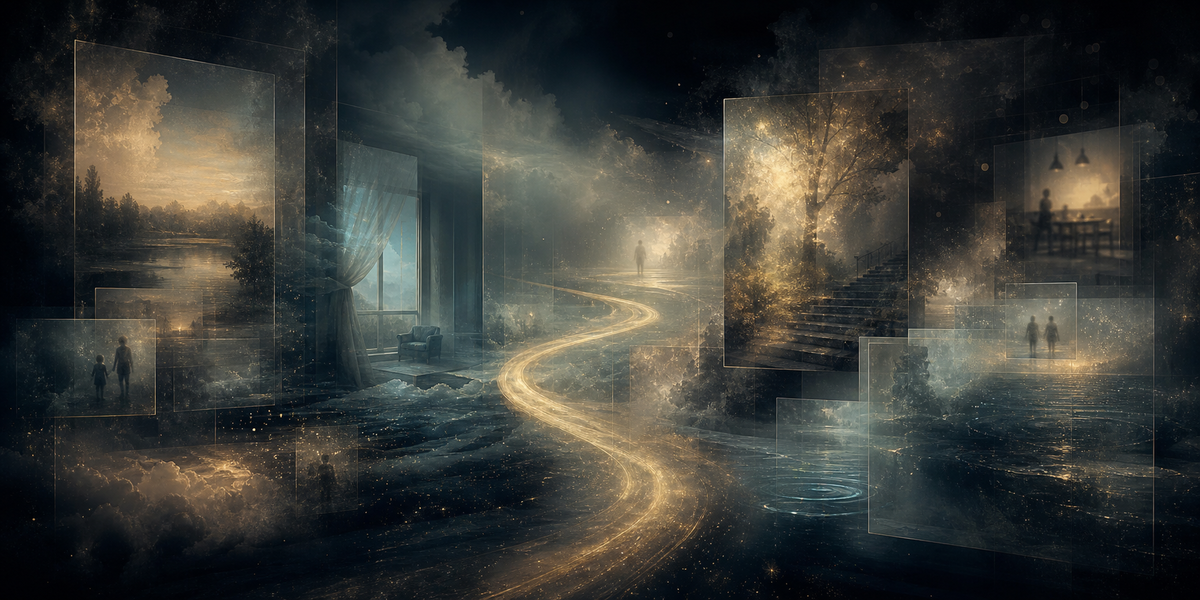
Memory matters on this site not simply as a theme inside stories, but as a formal principle — something that organizes how a film looks and sounds, not just what it depicts. Notes on The Mirror is central because memory in Tarkovsky’s film is not an object to be discussed from the outside; it shapes the film’s very composition. The essay’s anchoring claim — “Emotion, memory and senses are inseparable. One always evokes the other… cinema works through our senses to arrive at our memory, our emotion, this depth beyond all rational thoughts” — is the working premise of the entire memory thread.
The reading turns on what The Mirror did to its own form to fit the structure of remembering. Tarkovsky’s remark on editing — “in a sense they edit themselves; they join up according to their own intrinsic pattern” — registers the logic of an unbelievably disordered mixture of “vague events, floating faces, ephemeral gestures, which disappear and reappear constantly in a maze labelled space-whatever and time-whatever.” The essay reads Natalia, the wife introduced only during the shoot, as the figure who turns the title literal: present and past begin to reflect each other “in a bidirectional way: everything can be traced back and every shadow finds its substance.” The mirror itself — the prop that recurs in every register, from the fogged glass between mother and old self to the thirteen mirrors on a single wall in the doctor’s room — does the work the essay frames as memory’s: “not to construct, but to reflect, to reveal.”
The World Heard extends that intuition into theory. The dissertation’s “worlding theory” insists that the inhabitable depth of a remembered world is built audiovisually — that recollection on screen is not narrated but felt because sound, as much as image, gives the world its density. That is also why the slow-motion analysis in Notes on The Mirror matters here. Tarkovsky’s distinction between “disfiguring” slow motion (which “deforms the actress’s face… serves up the emotion we want, squeezes it out by our own means”) and the “barely perceivable” slow motion of Maria running in the rain is essentially a distinction between memory as cliché and memory as form.
In Praise of Mysterious Characters joins the cluster from a different direction. The mysterious character — Dwight in Blue Ruin, the Driver in Drive, Ben in Burning — is often, in the essay’s phrase, “a person whom life has made opaque even to themselves.” That formulation links character opacity to the structure of memory: a person who cannot be made legible inside their social context is often someone whose past has stopped narrating itself in everyday categories.
Read together, these pieces make the same wager: the important question about memory in cinema is less what a character remembers than how a film makes remembering itself perceptible — through duration, sound, atmosphere, opacity, and the kind of slow motion that does not announce its own significance.
Related
A central reference point for questions of memory, autobiography, time, and the audiovisual world of cinema.
Sound as a central force in cinematic world-building, immersion, and theory.
The idea that films build inhabited worlds rather than merely presenting images or stories.
Read Next
- Notes on The Mirror
Emotion, memory and senses are inseparable. One always evokes the other. This seemingly innocuous statement in fact leads to cinema’s greatest potential.
- In Praise of Mysterious Characters
The essay explores cinema's 'mysterious characters'—figures whose opacity resists even patient observation—arguing that withholding creates gaps that transform viewers into co-authors of character.