Ideas Not Words

Ideas Not Words
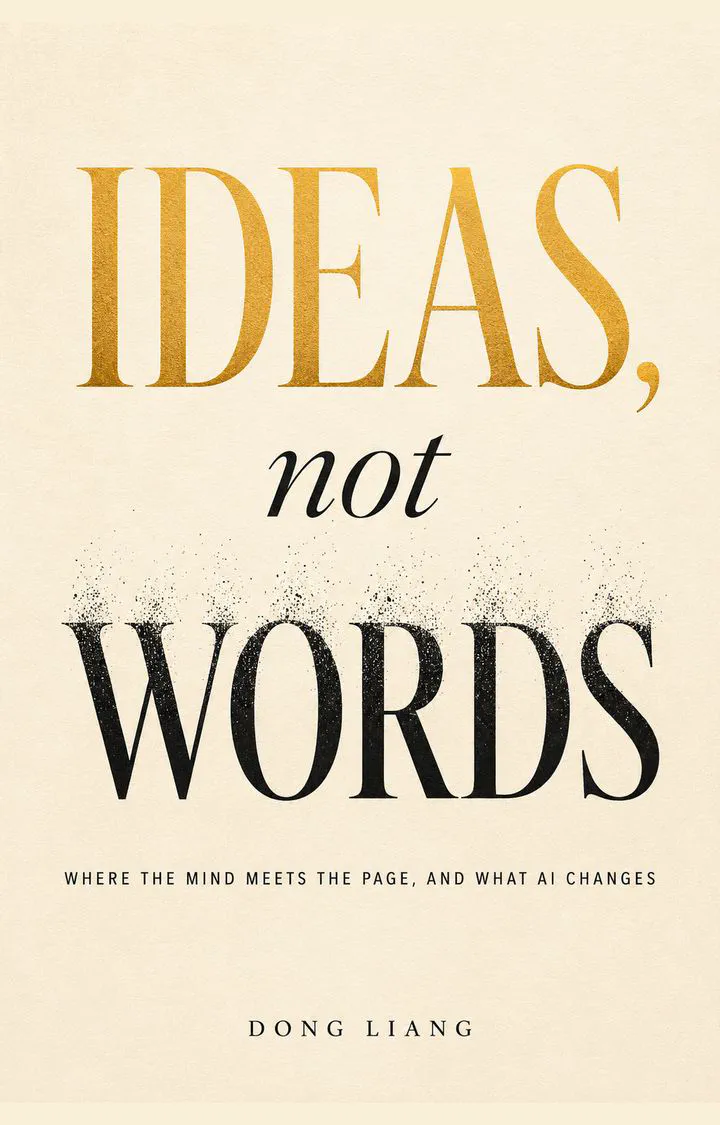
Ideas Not Words is out. You can get it now on Amazon, here. It’s a book about where AI genuinely helps the writing process. It is about how not to let AI quietly do the thinking for you; it is about working with AI through the lifecycle of your work: from how ideas get gathered in the first place to what happens to a writer’s voice under sustained use. It closes with a practical Field Manual you can start using the same day you finish reading.
It is almost strange the way this book came out. I didn’t sit down one day and decide to write a book about writing and AI. That wasn’t the plan. What I actually wanted was simpler: I wanted to understand how I could work with AI more productively, since I am determined to do both AI and writing at the same time. And I also genuinely want to help people who were struggling with this, not just repeat the advice already circulating, which mostly amounted to “use it more” or “don’t touch it.”
The more I sat with that question, the more I ran into a wall that had nothing to do with AI: the nature of writing itself. I couldn’t say where AI helps or harms writing, because I didn’t actually have a clear account of what writing is in the first place. Everyone assumes they know, because they can point to the writing they’ve already produced as proof. But almost nobody has worked the theory out carefully enough to test a new tool against it. So before I could answer the question I started with, I had to answer a harder one underneath it: what is writing, as a cognitive act, actually doing for the person doing it?
That’s the part of the book I didn’t expect to be writing. A theory of writing, although small and tentative, built from scratch. I wanted to have such a theory handed over to me but all I ever got was fragmentary reflections that sometimes explain, other times mystify. I know I need something solid enough to hold a second question up against: given what writing actually is, where does AI genuinely help, and where does it quietly take something away? In this book I have tried to offer an answer to both questions.
Theory vs. application
I know I have a tendency to theorize things. This showed in various personality tests and my wife complained about it numerous times. But I wish to insist on the validity of this approach here. The chapter on what writing is comes before anything about AI, because I wanted the argument to survive contact with tools that don’t exist yet. If I’d started from “here’s what AI can do for your writing,” the book would already be dated. Models change every few months. What doesn’t change nearly as fast is the underlying question of what happens in a mind when it writes, and what a tool would have to do to genuinely help with that instead of just producing more text faster.
So the throughline of the book is really: understand the machinery first, then ask what a lever does to it. Once you have a working model of writing as thinking, you can evaluate any tool, including ones that don’t exist yet, against the same standard. Does this help me think, or does it just help me produce.
Built to go out of date, on purpose
There’s a real problem with writing a book about AI tools: some of what I say about specific tools will be wrong within a year or two, not because I was careless, but because the tools themselves will have moved on. I didn’t want to pretend that problem away, so I designed around it instead.
The main chapters carry the theory, and I expect that part to hold up. The practical layer, the actual moves you make day to day, lives in a separate section I call the Field Manual, which I can update on its own schedule without touching the argument underneath it. And even inside the Field Manual, I split things further, into Principles and Situations. Principles are the decisions that hold regardless of which specific tool you’re using: own your data, don’t marry a single platform, treat your workflow as a chain of replaceable parts. Situations are closer to the ground, the actual moments in a writing process where AI changes the move, and those are the pages most likely to need revision as the tools change.
Looking back, I realize this structure is itself an application of the book’s central claim. The book argues that writing with AI works best when you separate the idea, which is durable, from the words, which are disposable and easy to regenerate. I ended up building the book the same way: durable argument at the center, disposable specifics at the edges, organized so the second can be rewritten without disturbing the first.
This is also a large part of why I chose to self-publish rather than go through a traditional press. A traditionally published book is fixed the moment it goes to print, one edition, frozen at whatever the tools looked like on that date, revised only years later if a second edition happens at all. That timeline doesn’t match a subject that moves every few months. Self-publishing meant the Field Manual could actually behave the way I designed it to behave: I can go back in and update it as tools change, without waiting on anyone’s schedule but my own. As a result, I have already updated the book twice since it was first published. I wanted a book that could keep pace with the thing it was written about, and the traditional path wasn’t built for that kind of upkeep.
I don’t think the book closes any question, and I didn’t want it to. I am still tweaking my process, inventing and validating new tools. The most honest thing I can say is that I built a framework I trust, tested it by writing the book itself with the same tools it describes, and I’m still watching where it holds and where it doesn’t.
I’ll also say plainly that the whole process has been smoother and more rewarding than I expected going in. Rewarding enough that I’m now seriously considering doing something similar with my dissertation, not for any career reason at this point, just for the satisfaction of finally putting it into the world in a form other than a bound copy on a shelf.
That’s part of why this site exists alongside the book. The book had to stop somewhere. The thinking didn’t.

Comments