In Praise of Mysterious Characters

 TBA
TBA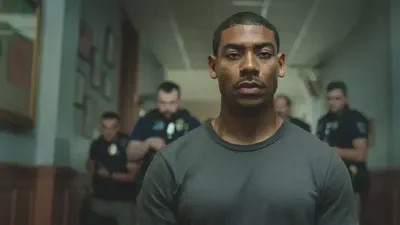
In Rebel Ridge (2024), Terry Richmond is stopped by two small-town police officers who confiscate the cash he was carrying to bail out his cousin. What follows is a slow, inexorable confrontation. Terry is soft-spoken, almost unnervingly so — he cites legal procedures, speaks in complete sentences, never raises his voice. He is also, we quickly gather, a former Marine who is physically capable of severe violence. The film withholds whether he will use that capability. More than that: it withholds why he is choosing not to. His restraint does not look like fear. It does not look like calculation. It looks like something more internal — a commitment whose source the film refuses to explain. We watch him move through mounting provocation and understand almost nothing about the architecture of his self-control.
A case of a mysterious character.
Three Modes
It seems to me that cinema has, broadly speaking, three ways of presenting human beings to its audience.
The first I would call the explanatory mode, exemplified by classical Hollywood cinema. In this mode, storytelling explains everything within the story. Events must make perfect sense for adults and children alike. Characters want things, encounter obstacles, reveal themselves through conflict, and change in legible ways. Mystery, when it appears at all, is a plot device — a secret waiting to be disclosed, not a permanent condition of the person. By the time the credits roll, no one’s motivations are in doubt.
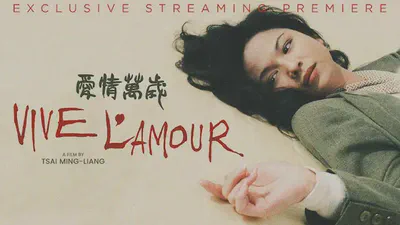
The second mode is immersive. Films by Tsai Ming-liang, Carlos Reygadas, or early Antonioni place you inside a world where you have partial access to the characters’ inner lives. You observe them — eating, sleeping, standing in doorways — without ever quite knowing what they are thinking. In Vive L’Amour, three strangers share a Taipei apartment without acknowledging each other, and Tsai’s long static shots make you feel the specific texture of urban loneliness without ever labeling it. The character’s interiority is not hidden exactly; it simply exceeds what can be said. The silence is not a refusal — it’s an acknowledgment that some states of being resist articulation.
The third mode produces what I am calling mysterious characters. Here something different and more radical is at work. These characters are not merely inward; they are opaque in a way that resists even patient observation. Before they speak, their behavior does not reveal their ultimate motivations. And sometimes — this is the crucial distinction — even their words fail to explain their actions. They can appear contradictory: gentle and violent, principled and ruthless, ordinary and alien. They do not simply have depths; they have depths that resist your every attempt to sound them.
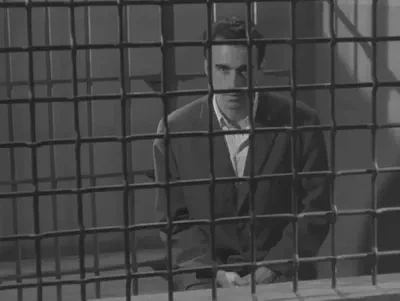
Robert Bresson is the presiding spirit here, though his direct influence is less important than his insight. His actors — whom he insisted on calling models — were not asked to express. They were asked simply to be present. Feeling, Bresson believed, would be captured by the camera before it was performed by the face. Later filmmakers, working in very different registers, have inherited and extended this principle far beyond the austere conditions of Bresson’s own art.
A Gallery

Dwight lives in his car, picks through trash, sleeps on beaches. A grief whose full shape the film never discloses has reduced him to subsistence. When the man who killed his parents is released from prison, Dwight decides to act — but his revenge is fumbling, amateur, wrong in almost every practical respect. What is strange is that we never access his grief directly. We know it exists; we can see it has carved him out. But he doesn’t articulate it, and the film provides no flashbacks, and so we construct his psychology entirely from the outside — from the awkward way he holds a gun, the social panic in his face, the steadiness that comes from having already decided something irreversible.
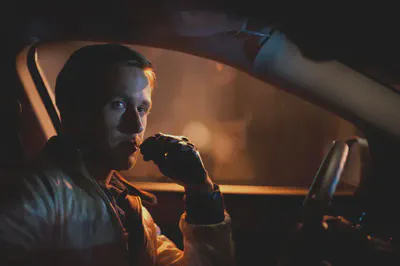
The Driver has no name, no backstory, and almost no dialogue. He operates by a code whose origins the film does not explain: he will protect the people he decides to protect, and he will be extraordinarily violent toward anyone who threatens them. Ryan Gosling plays him in a register of near-total blankness. The violence, when it comes, does not read as anger or even purpose — it reads as something closer to natural law. What makes the Driver mysterious is not that he conceals his feelings but that he seems to exist prior to the psychological vocabulary we would need to describe feelings at all.
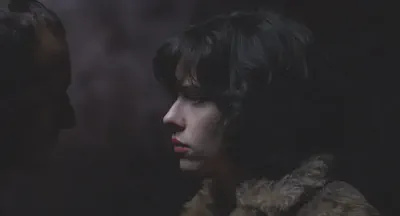
The alien woman — she has no name — drives through Glasgow picking up men who will not be missed. We watch her observe herself in a mirror, copy human expressions, eat chocolate and find it strange. Whether she feels curiosity, contempt, or something without a human name, the film cannot say — perhaps because the relevant concepts don’t apply. What is remarkable is that this opacity generates not distance but a vertiginous identification. We watch her watching us, and begin to see ourselves from the outside. Mystery here is not a psychological condition but an ontological one.
What the Opacity Does
These films share a wager: that withholding produces more than disclosure. The mysterious character creates a gap, and the viewer fills it — with projection, with autobiography, sometimes with dread. What you bring to a face that won’t perform its feelings is inevitably something of your own. The audience becomes, in this sense, a co-author of the character.
This is not opacity for its own sake. The mysterious character tends to appear in films concerned with people who cannot be made legible within their social context — who have crossed some threshold of experience that ordinary behavioral codes cannot accommodate. Dwight’s clumsiness is what inconsolable grief looks like when it finally tries to act. The Driver’s code of protection and violence has clearly been forged somewhere the film will not take us. The alien woman in Under the Skin moves through Glasgow as though human behavior were a recently acquired language she is still translating.
The mysterious character is often a person whom life has made opaque even to themselves.
The opacity can be fragile. And it can be a tease instead of a philosophical statement. Rebel Ridge followed the arc established by Blue Ruin, both by Saulnier, approaching and retreating from that very opacity. Blade Runner 2049, too, dismantles its own mystery through physical restraint. Both films start with a classic showcase of character opacity: Terry Richmond’s soft-spoken refusal to escalate, K’s near-expressionless performance of compliance. In both cases, the actor’s face does the work — microexpressions, posture, the precise way a body occupies space — and we read these surfaces carefully because the film has trained us to.
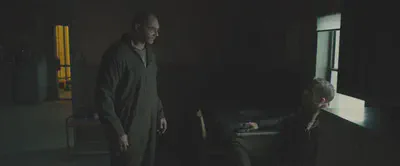
Then both films pivot. The action movie they have been deferring arrives: Terry Richmond is permitted his violence; K his sacrifice. The shift is not merely tonal. The character who was defined by what he withheld is now defined by what he does, and large-scale physical action is legible in a way that a contained face is not. We understand exactly what these men are in their final sequences. That understanding is, in its way, satisfying. But it closes off the more interesting question the films had been asking. The release is palpable. So is what it costs.
Burning
Burning proposes a different solution to the problem the essay has been circling. The films in the gallery above — Blue Ruin, Drive, Under the Skin — maintain their opacity at the cost of a certain distance. We admire them more than we inhabit them. The compromise films respond to this distance by eventually delivering legible action, but they pay for that delivery with the mystery they built. Burning finds a third path by splitting the work between two characters.
Jong-su — the protagonist — is entirely legible. His emotions are available to us at every moment: the love for Haemi that is partly longing and partly possession, the class resentment that colors everything he sees, the writer’s obsessive need to assemble meaning from scattered evidence. We are in his perspective from the first scene. We understand him the way we understand a character in a novel.

Ben is something else entirely. Wealthy, leisured, disconcertingly at ease, he enters Jong-su’s life and never resolves into a coherent person. Their conversations feel like interrogations whose object keeps slipping. He mentions, almost casually, that he occasionally burns old greenhouses. Whether this is metaphor, confession, provocation, or a species of private performance, the film declines to say. Steven Yeun plays him with a smile that never quite becomes meaning — friendly without being warm, forthcoming without revealing anything. He is, in the precise sense this essay has been developing, a mysterious character.
The masterstroke is what the film does with Ben’s putative action. He may have killed Haemi. He may burn people the way he says he burns greenhouses. This extreme act — the most externalized violence in the film — is withheld entirely. We never see it. We only have Jong-su’s interpretation, assembled from fragments, and the film refuses to confirm whether that interpretation is correct. Ben’s opacity extends to the act that should, by genre logic, define him.
When the violence finally arrives, it is Jong-su who commits it: he stabs Ben and burns his car in the dark. The audience has had someone to identify with throughout — someone whose paranoia and grief have been fully available — and the film delivers the externalized action the genre has made us expect. But Ben’s mystery survives his death. The final image gives us Jong-su walking away from the flames, and we still cannot say whether he was right. The opaque character has not been explained by the violence done to him. He remains exactly what he was at the beginning: a person you could not get behind.
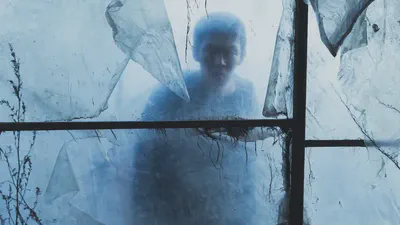
This is the solution Burning offers to the problem that sinks Rebel Ridge and Blade Runner 2049: give the audience a surrogate who feels everything the mysterious character withholds, let the surrogate perform the violence the genre requires, and preserve the mystery in the figure who never had to carry the audience’s identification in the first place. The best films of this kind do not ask us to inhabit the opaque character — they ask us to watch someone else fail to read them. The mystery survives because solving it was never the point. It was always the engine.