The Slop Problem

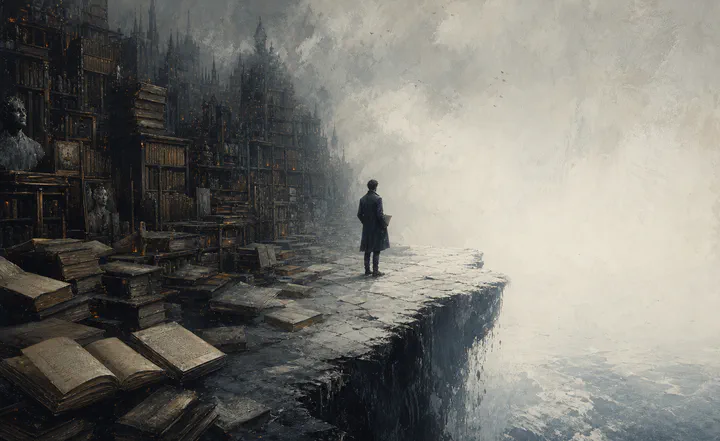 Slop is at center, Insights at edge
This is a chapter from my book manuscript Writing in the Age of AI. If you are interested in publishing, an overview, table of contents, and additional sample chapters are available upon request.
The public conversation about AI and writing has polarized into two camps, and both are wrong in instructive ways.
Camp A says AI can only produce inferior work. Since AI cannot write as well as a human; they have little use for it. Not only do human writers have nothing to fear but also that they should not touch AI for writing assistance: it will always be a degradation. Camp B says AI can and will produce everything, eventually if not now. If writing is about churning out coherent words, then human writing is inefficient, biased, slow. The future is prompt-driven content at scale.
Camp A is somewhat comforting for serious writers but makes them complacent; it also does not completely eliminate the fear of missing out. Camp B has its own champions: the marketer who reaches for AI to brainstorm ideas without realizing the model has no ideas of its own, the social-media manager who feeds AI a topic at 9 a.m. and posts the result by 9:01. This camp takes writing as what they use writing for. Hence writing becomes a production problem (how to generate more text faster) rather than a thinking problem.
Most readers, of course, fit in neither camp cleanly. They feel both pulls at once: drawn to AI for some reasons, wary of it for others, unsure which instinct to trust. But that doesn’t make their position any better: to AI or not to AI, that’s still a question.
What neither camp has examined closely is the actual output. Writers have a name for what they find there. They call it slop.
What Slop Is

Slop is not bad writing in the traditional sense. It is not incoherent, poorly structured, or grammatically deficient. It is, in its way, technically accomplished. What it lacks is a specific mind. It is generated writing: the statistical center of all similar content the model has encountered, fluent and hollow in equal measure.
You have read slop. You may not have known the word for it, but you recognized the feeling: the uncanny smoothness of a LinkedIn post that says nothing in four paragraphs, the travel article that hits every expected beat without once surprising you, the blog post that reads like a composite of every other blog post on the topic. Before AI, we called this kind of writing “generic” or “forgettable.” Now we call it slop, because AI has given us a production mechanism that reveals what “generic” actually means: it means statistically average. It means the center of the distribution. It means the text that a probability engine would produce if you gave it a topic and asked it to write.
Here is a fresh example, generated in seconds:
In today’s fast-paced digital landscape, effective communication has become more important than ever. As businesses navigate the complexities of the modern marketplace, the ability to convey ideas clearly and compellingly can make all the difference. Whether you’re crafting an email to a client or preparing a presentation for stakeholders, the principles of strong writing remain timeless.
Four sentences. No claim that wasn’t already made a thousand times. No idea you could not have predicted from the opening phrase. Nothing about this business, these stakeholders, this client. The form is intact. The mind is missing.
The anatomy of slop reveals exactly where the process failed. When a writer prompts a model to “write an article about effective communication,” they have provided a topic but no seed, no genuine nucleation point around which ideas can crystallize. The model cannot invent one. So it produces the expected path: the argument everyone already knows, supported by the examples everyone already reaches for, in the register most commonly associated with this kind of writing. Competent. Forgettable.
A language model generates text by sampling from a probability distribution over possible next tokens — a distribution learned from billions of training examples and tuned by post-training feedback. The model can be set to make safer or wilder choices, but the underlying distribution is the same either way. What it encodes is what training has marked as typical. The model’s default output is the statistical center of all the writing it has seen on a given topic: the average argument, the expected examples, the most common register.
This is not a bug. It is the architecture. The model is designed to produce probable continuations. When those continuations are factual summaries, code completions, or translations, the statistical center is exactly what you want: accuracy, consistency, the expected answer. But when the task is creative writing, the statistical center is precisely what you don’t want. Creativity, by definition, lives at the edges of the distribution. An insight that could have been predicted from the training data isn’t an insight.
This is why prompt engineering for creative writing meets its hard limit. You can steer the model away from its default center. Ask for unusual perspectives, demand surprising connections, specify that the output should be non-obvious. But you are still asking a probability engine to produce improbability. The model can move away from the center, but it cannot move toward a specific edge because it doesn’t have an edge to move toward. Only a human mind, one that has experienced, observed, and connected in a way no other mind has, can supply the specific direction that makes writing genuinely original.
When Craft Is Not Enough

The argument that AI produces slop implies a contrast: that humans, left to their own devices, produce something better. But that contrast deserves examination. Most human writing, or most of what gets published, shared, read, is closer to formulaic than to inspired. The bell curve is real. Most novels are competent. Most journalism is predictable. Most business writing is filler. The percentage of human writing that carries genuine insight, the kind that reframes, that surprises, that could only have come from this mind, is small. But it is not zero. What separates that small remainder from everything else, and whether AI can cross that divide, is the question both camps have been too invested to ask carefully.
The instinct to teach writing, to make the craft analytical, transmissible, learnable, predates language models by nearly a century. The Iowa Writers’ Workshop, founded in 1936, was the first sustained American attempt to do for prose what conservatories had long done for music: turn an apprenticeship that had been informal and idiosyncratic into a structured program with shared vocabulary, repeatable exercises, and a community of practice. The achievement is real and ongoing. The workshop democratized craft, gave aspiring writers a path that did not depend on patronage or geography, and produced a long roster of recognizable writers.
The instinct broadened well beyond Iowa. John McPhee taught a course on creative nonfiction at Princeton for half a century. His lessons on structure, on selection, on the eight-month wait for the right tinder, are simultaneously lessons in how to discover what a piece is about. Good craft instruction has always understood that the line between the teachable and the unteachable is porous. Even the template industry (more formulaic, more market-driven) provides useful scaffolding in the hands of writers who bring their own seed.
The slop problem is not a problem with craft instruction as such. Craft is necessary, and the world needs more of it, not less. This book itself can be considered a craft book, one that includes AI as a participant in the process rather than as a competitor to it. My argument is not against the craft. It is about a specific failure mode that any craft tradition can fall into when its lessons are applied without a seed.
The failure mode is mechanical application. Any teachable practice can be executed as a routine: the three-act structure as a checklist, the show-don’t-tell as a habit, the McPhee structural diagram as a recipe rather than a tool of inquiry. AI can be the new recipe. It produces competent sentences, sound structure. The piece will read as professional, and read as nothing else. This is slop. It is what happens when craft does what craft does without anyone behind it.
What AI now makes visible is the shape of this failure mode at scale. A language model is, in effect, an optimization engine: it produces what is statistically probable given the patterns in its training data. Any teachable craft is also, in its way, an optimization process: students adjust their work toward patterns that experienced readers recognize as “good writing.” The two processes are not identical: one happens in a mind that can break its own pattern, and the other does not. But the surface output, given a topic without a genuine seed, can converge to a surprising degree. The convergence is what makes the comparison useful. It clarifies what insight has to do that even the best craft, by itself, cannot.
AI has craft. Not the appearance of craft, but craft itself, in the sense craft has always meant: the command of patterns that experienced readers recognize as good writing, acquired through exposure to enough examples, executable on demand. A child of nine at a piano can play a Chopin nocturne technically. The notes are correct, the timing is acceptable, the dynamics land in the right neighborhood. What the nocturne means, what a player has to have lived for the same notes to break a listener, is something else, and arrives later if it arrives at all. AI sits where the early stage of that trajectory sits. The technique is real. The interpretation is what the chapter is still trying to name.
Saying AI has craft is not the same as saying AI is a great writer. It says craft is not, by itself, what makes a great writer. Humans have always known this and forgotten it and rediscovered it and forgotten it again. AI’s contribution is to make the forgetting harder. When the machine can produce craft on demand, the question of what is left becomes impossible to avoid.
Craft is necessary. It is not, by itself, sufficient. This is true of the workshop, true of the template, true of McPhee’s structural diagram, and true of the craft this book is attempting to articulate. The seed is what every craft tradition has assumed and rarely had to defend, because the seed used to be the only thing a writer arrived with. AI changes that, because AI will fill the absence of a seed with a fluent surface that hides the absence.
Writing is for…

The slop problem looks different depending on who you believe writing is for, and this is where the two camps from the opening reveal their deepest disagreement.
If writing is communication, the transmission of information from one mind to another, then AI wins. It communicates more, faster, at lower cost, with fewer errors. The market for writing-as-communication will be dominated by AI, and this is neither tragic nor avoidable.
If writing is craft, the skilled arrangement of words into pleasing, effective structures, then AI contributes. It already produces craft-level prose that passes most reader tests.
If writing is thinking, the process by which the writer discovers what they didn’t know they knew, then AI is a tool, not a competitor. The value is in the transformation that happens in the writer’s mind during the act of writing. The output is evidence of the thinking, not a substitute for it. AI can accelerate, scaffold, and pressure-test that thinking, but it cannot do the thinking, because the thinking is what happens to the human in the process.
The danger lives at the third level. Camp A never gets there because it won’t use AI at all. Camp B gets there constantly without noticing, because the surface stays fluent even when the thinking was never there. That is where slop hides.
Photography made this kind of separation legible a century before AI. Before the camera, a commissioned portrait served two purposes that had never needed to be distinguished. It documented what someone looked like, and it expressed how a painter saw them. Both lived in the same object. The aristocrat who sat for a portrait needed both, and there was no cheaper alternative for either: if you wanted your likeness preserved, you paid for the painting, and the painter’s vision came along whether you valued it or not.
When the camera arrived, it absorbed the first function entirely. What had required hours of sitting and a trained hand now took an instant. Not everyone could afford to commission a portrait. Photography put the documentary function within reach of anyone who could hold a camera. The separation that followed was swift and decisive: communicative image-making moved to photography; painting was left with everything the camera couldn’t do.
What the camera couldn’t do turned out to be exactly painting’s new mission. Stripped of its documentary utility, painting had to reckon with why it still existed. The answer was the one that had always been there, obscured by usefulness: the expression of a particular way of seeing. Not the reproduction of appearances (the camera did that better) but the revelation of a vision no mechanism could replicate. The portrait as record went to photography. The portrait as seeing stayed with painting, and stayed with it more clearly than before.
AI will make the same separation in writing. Text that is purely communicative (the summary, the report, the brief, the product description and manual) will go to AI the way the documentary portrait went to the camera: faster, cheaper, requiring no specific mind. The market for writing-as-communication will not contract; it will expand. The Jevons paradox holds: making a resource more efficient increases, not decreases, its consumption. The total volume of text in the world will multiply beyond recognition. Most of it will be consumed and forgotten as quickly as a photograph on a phone screen. What remains, what endures in the way that painting endured, will be the writing that carries a specific mind’s way of seeing. Not writing-as-information. Writing-as-thinking.
Why We Write

Writing is also how we establish who we are. It is how a self gets made visible, to others and to the writer. AI produces slop not only because it cannot do the work of thinking, but also because it has no one to be. Two absences, not one, and both feed the same statistical center on the page.
Orwell named this directly in his 1946 essay “Why I Write.” He lists four motives that operate in every serious writer to varying degrees: sheer egoism, aesthetic enthusiasm, historical impulse, and political purpose. Your list may look different. Orwell’s political purpose was the one his life had forged: five years as a colonial policeman in Burma, the fight against fascism in Spain, the slow recognition that English socialism had to be argued for in plain prose against the rising clarity of totalitarian propaganda. His aesthetic enthusiasm was the love of language his particular reading had given him. His egoism was the specific vanity of the boy who had been miserable at St. Cyprian’s. His historical impulse was shaped by his moment. He doesn’t list motives writers might have. He lists what is feeding him when he writes, and the motives are inseparable from the person.
Orwell tested this insight against his own work. “It is invariably where I lacked a political purpose,” he wrote, “that I wrote lifeless books and was betrayed into purple passages, sentences without meaning, decorative adjectives and humbug generally.” Slop is a name for that betrayal. The political purpose, when it was there, was him; without it, the prose became someone-else’s-or-no-one’s. The same pattern shows up across writers, almost universally. What makes their writing recognizably theirs is not technique. It is the unmistakable presence of a particular person on the page, with their reasons, their obsessions, their wounds.
Burma was not raw material that Orwell poured into sentences. Burma was a set of experiences that became Orwell through the writing about them. The colonial policeman who returned to England was not yet the Orwell of “Shooting an Elephant”; that Orwell was made on the page, by the act of finding the words for what the policeman had seen. The political purpose he names in “Why I Write” is not just a motive he carried into the writing. It is something the writing built in him over time. The writing did not record the writer it had. It made the writer it would have.
A language model can produce a competent sentence on any topic. It can produce a sentence that is recognizably Orwell’s. But the model has no Burma, no Spain, no St. Cyprian’s. It has no reason that any particular sentence had to be written rather than its statistical neighbor. Without identity, even the best craft falls back on the statistical center. And the statistical center is what slop is.
Another simple example.
Georges Perec’s 1969 novel A Void was written entirely without the letter “e.” An AI could replicate this constraint instantly. Lipogrammatic generation (writing that omits a chosen letter) is a straightforward technical challenge. But the constraint was not the point. The letter “e” is phonetically linked to the French word “eux” — “them.” Perec’s parents were Polish Jews who perished during the Holocaust. The absent letter enacts the absent people. The formal constraint is a monument to a specific grief, and every sentence is simultaneously a feat of construction and an act of mourning. A Void without the biographical context is a clever lipogram. With it, it is one of the most moving novels of the twentieth century. The text is the same in both cases. The meaning is not.
The idea that human creativity rests on lived experience has a distinguished lineage, and it is the argument writers have leaned on for a century when defending the human side of any new machine.
In 1842, Ada Lovelace observed that Babbage’s Analytical Engine had “no pretension to originate anything.” It could execute, but not invent. A century later Alan Turing, who believed machines could think more readily than most of his contemporaries did, still drew a line: a computer could simulate a great many things, but it could not enjoy the taste of strawberries and cream. To this day, we build the defense on the same ground: no experience, no inward life; no inward life, no literature.
The argument is correct as far as it goes. Lived experience is necessary for great writing. A writer working without an experiential substrate produces hollow text: recombinations of patterns the writer never moved through, prose that knows the shape of meaning but not its weight. On this point, the lived-experience camp is right, and the right move is to grant it plainly.
But necessity is not sufficiency, and the slip between the two is where the defense folds. Plenty of humans with extraordinary experiences produce terrible writing. Suffering does not automatically become literature. War does not automatically become poetry. Most soldiers did not write Catch-22; most widows did not write The Year of Magical Thinking. Experience is the raw material; the writing process is the alchemy that converts the one into the other. The lived-experience camp often skips this middle step entirely, treating experience as if it transmits directly into art. It does not. It has to be worked.
The writing process is not just an alchemy that converts experience into prose. It is an alchemy that converts the writer at the same time. Burma did not just become “Shooting an Elephant”; Burma became Orwell, who then could write that essay. The widow did not write The Year of Magical Thinking because she was a widow; Joan Didion wrote it, and the writing of it changed who Joan Didion was. The experience is necessary. The writing is the alchemy. And the alchemy works on the alchemist.
If AI someday acquires what the lineage said it could not — sensorimotor data, embodied experience, a continuous stream of being in the world — the lived-experience argument folds. The transformation argument does not. There must be a self the writing has changed and a self the writing is changing. AI has no such self. It has weights. The weights do not become anyone.
What You Bring

Now what should we do about the slop problem?
Think about the infinite monkey theorem: give a monkey a typewriter and infinite time, and it will eventually produce the complete works of Shakespeare — not because it understands what it’s typing, but because random processes, given enough attempts, will produce any finite sequence of characters. Most people find this conclusion technically difficult to challenge but practically absurd. The time required would exceed the age of the universe by many orders of magnitude. The scenario functions, in practice, as an impossibility.
Now ask the same question with AI in the picture. A language model is not a monkey. It doesn’t type randomly. It has read more text than any human could read in a thousand lifetimes, and it generates output shaped by all of it. It can produce millions of texts a day. The AI version of the monkey question is no longer absurd: yes, AI can probably reproduce Shakespeare-like writing, easily.
Suppose AI generates, at scale, paintings indistinguishable from Van Gogh’s in style, technique, and emotional register. The question is not whether these are “real” Van Goghs. The question is: so what? Van Gogh already exists. And what made him Van Gogh was not the surface (the thick impasto, the swirling skies, the saturated color) but the fact that no one had seen like that before. He was standing at a frontier no one had crossed, and the frontier was inseparable from the specific person standing on it: an autodidact who failed at every vocation he tried until the painting, a man writing those letters to his brother Theo, a particular nervous system breaking down in a particular village in Provence. Strip the person and you have the surface without the origin. The copy is proof that the frontier has been closed, not that a new one has opened.
The same logic applies to writing. AI can produce prose in the manner of Hemingway, Proust, Kafka and will do so with increasing fidelity. But the next great writer is not someone who writes like any of them. The next great writer is someone who articulates something about now: this specific moment, this friction, this thing the world has not yet found words for. A great writer makes readers feel: yes, that is exactly it, I couldn’t have named it but now that you have I can’t unsee it. That requires presence at the actual frontier of writing. It is a frontier of the present, where a specific life is being lived right now, in a moment no dataset contains.
The question is not whether our AI monkey can produce Shakespeare; it is whether it can be the next Shakespeare. We are not looking for someone who writes like Shakespeare, but someone who, like Shakespeare, arrives at a form nobody had before and reorganizes how everyone after thinks. That is what greatness has always been: not the mastery of a prior form, but the origination of a new one.
AI lacks lived experience by design. The design may not stay this way; research is moving toward systems that learn from continuous streams of the world. But the argument here does not rest on the gap closing — the writer is not absent. The writer arrives with what the model lacks: a seed, an experience, a reason this particular sentence has to be written. AI amplifies what the writer brings. When the writer brings nothing, the amplifier produces the statistical center. When the writer brings a seed, the same machine produces something the writer alone could not have produced.
Slop is not a model failure. It is an absence failure: a writer reaching for the page with no seed, no identity-shaped insight, nothing the model can amplify. Give the model that absence and it will produce the statistical center of what others have already said. Give it a genuine seed, rooted in who you are, and the same tool produces something else entirely. Its work shifts from generation to amplification. This is a fundamentally different and more productive operation. The model that produces slop when given a topic produces something alive when given an insight.
But what can we really bring? My answer: a special kind of expertise working with AI. Some of the loudest claims about what AI can and cannot do are made by people who have spent a few hours with the model. They typed a prompt, watched what came out, and formed their verdict. Imagine someone handed a piano for the first time, given two hours to practice, and then asked to judge the instrument’s range. Whatever they produced in those two hours would be the entire basis of their assessment. They would not be wrong to say what they could not yet do on it. They would be wrong to say the piano could not do it.
AI is an instrument, just like the piano. Camp A picked it up, played a few minutes, declared the sound flat, childish, and put it down. Camp B assumes the instrument can actually compose music, that you can hand it a topic and a beautiful recital comes out. Both are missing what every instrumentalist learns within the first year. The music does not live in the instrument. It is also difficult to say it lives in the player in its latent form. It lives in the contact between them, in the finger on the key, in the precise instant of weight, in the angle that lets a chord ring rather than thud. The contact surface is where the expertise is, and the expertise is intricate.
Your hand was not made for a piano keyboard. It was made for branches, for tools, for the work of an upright primate. The keyboard was designed with the hand somewhat in mind, but the design is imperfect, and the spread of your fingers determines how many octaves you can reach. Some pianists can play tenths; some cannot. The instrument and the body are in a relationship that has to be learned, by both, over time. Your brain’s contact with AI is of a similar nature. The brain was not made for this either. The model was not made perfectly for the brain. The contact between them is where the writing now happens, and the contact is being learned: by the writer who is figuring out what to ask, where the model is strong, where it fails, what conversation moves get past the default, what work is best done together and what is best done alone, and by the model itself as the research keeps moving. The shape of the instrument matters. The shape of the player matters. And the practice that brings them into useful contact is real, ongoing, and largely undiscussed.
The seed is what you bring; the contact is what you do with what you brought. The writer with neither gets the statistical center back. The writer with both gets something neither could have produced alone.
The input determines the output, and the input is you.

Comments